


The P. & N. de Boer Foundation celebrated its 50th anniversary in 2014, but the basis for the collection was laid decades before 1964. It was only after the death of his wife Nellie Pressburger in 1960 that Piet de Boer decided to retire after 40 years as an art dealer, and to transfer the collection of paintings and drawings that he had put together over more than two decades to a foundation that was named jointly after her.
Pieter de Boer (1894-1974), the eldest son of the historian Michael Georg de Boer (1867-1958) and Anna Dommering (1872-1928), initially studied zoology in Zürich and Amsterdam, but in 1919 he decided to abandon his studies and prepare instead for a career in the art trade. He attended lectures on art history given by Prof. W. Vogelsang in Utrecht and Prof. W. Martin in Leiden, and got a job with the framers J.S. Fetter & Co., who wanted to build up an art department.
After a while he moved to the firm of Mak in order to develop his skills further. He opened his own gallery specializing in old master paintings in 1922 at his home in the Van Eeghenstraat, assisted by his younger brother Dolf de Boer (1900-1987), who had gained experience at the art dealers E.J. van Wisselingh & Co. and elsewhere.
After only two years, the gallery moved to a modest canal-side house, Prinsengracht 849, which was exchanged in 1927 for the far roomier building at Herengracht 464. In 1940 the firm moved again, this time to the majestic town house at Herengracht 512, where it still is today. In Amsterdam, which was still a very important city in the international art trade, the firm rose to third place in the ranking of dealers in old master Dutch art, after J. Goudstikker and D.A. Hoogendijk. Piet de Boer followed the example of Jacques Goudstikker by organizing art-historical exhibitions that shed light on areas that had been little explored until then, with loans from others being displayed alongside works for sale. In addition, the firm put on its usual commercial exhibitions, adding drawings to the paintings in 1930. The trade in drawings never became its main focus, but it did lie at the heart of Piet de Boer’s private collection, which gradually accrued in the 1940s and 50s.
In the space of a few decades De Boer acquired hundreds of drawings, partly at auction and partly from fellow dealers and collectors. The core consists of 17th-century Dutch sheets, but the 16th century is also very well represented, and there is a not inconsiderable number of 18th-century works. The drawings were not exclusively Dutch, but included French, Italian and, to a lesser extent, German sheets.
Landscapes take pride of place, but there are also religious works, cityscapes, genre scenes, figure studies and a few portraits. The 19th century is absent almost completely, apart from work by Vincent Van Gogh, for whom Piet de Boer had a particular fondness.
Compared to the broad and consistent collection of drawings, the foundation’s holdings of some 80 paintings collected by Piet de Boer is far more heterogeneous, in quality as well. One gets the impression that the decision to build up a collection of paintings was taken later, which is not surprising, given the fact that in the years when he was still an active dealer in paintings he could easily have become his own competitor by collecting for himself on any serious scale. The collection consists of clearly defined areas of interest, some of which are mirrored in the drawings, such as early art of the 15th and above all 16th centuries from the Low Countries, supplemented with a few German examples, and landscapes. There are also several remarkable Dutch still lives, mainly for the first half of the 17th century. The small group of Italian paintings is of variable quality. There is a special place in both collections for the work of Vincent Van Gogh. Piet de Boer acquired no fewer that seven of his works over the decades, three paintings and four works on paper, which are a high point of the foundation’s collection.
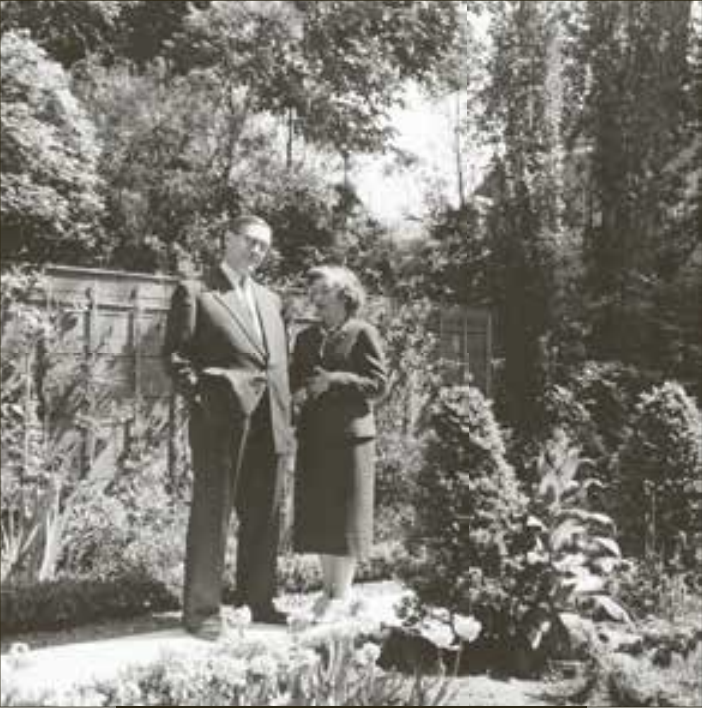
Piet and Nellie de Boer in the garden of the Herengracht 512, early 1950s

The ‘Drawings Room’
with the 18th-century cabinet in which part of the drawings collection was conserved, c. 1950

Piet and Nellie de Boer on the beach in Zandvoort,
early 1930s

Pieter Aertsen, The adoration of the Magi, oil on panel, 167.5 x 179 cm, P.&N. de Boer Foundation, inv.no. B 2, on loan to the Rijksmuseum, Amsterdam.