
Leiden 1633 – London 1707
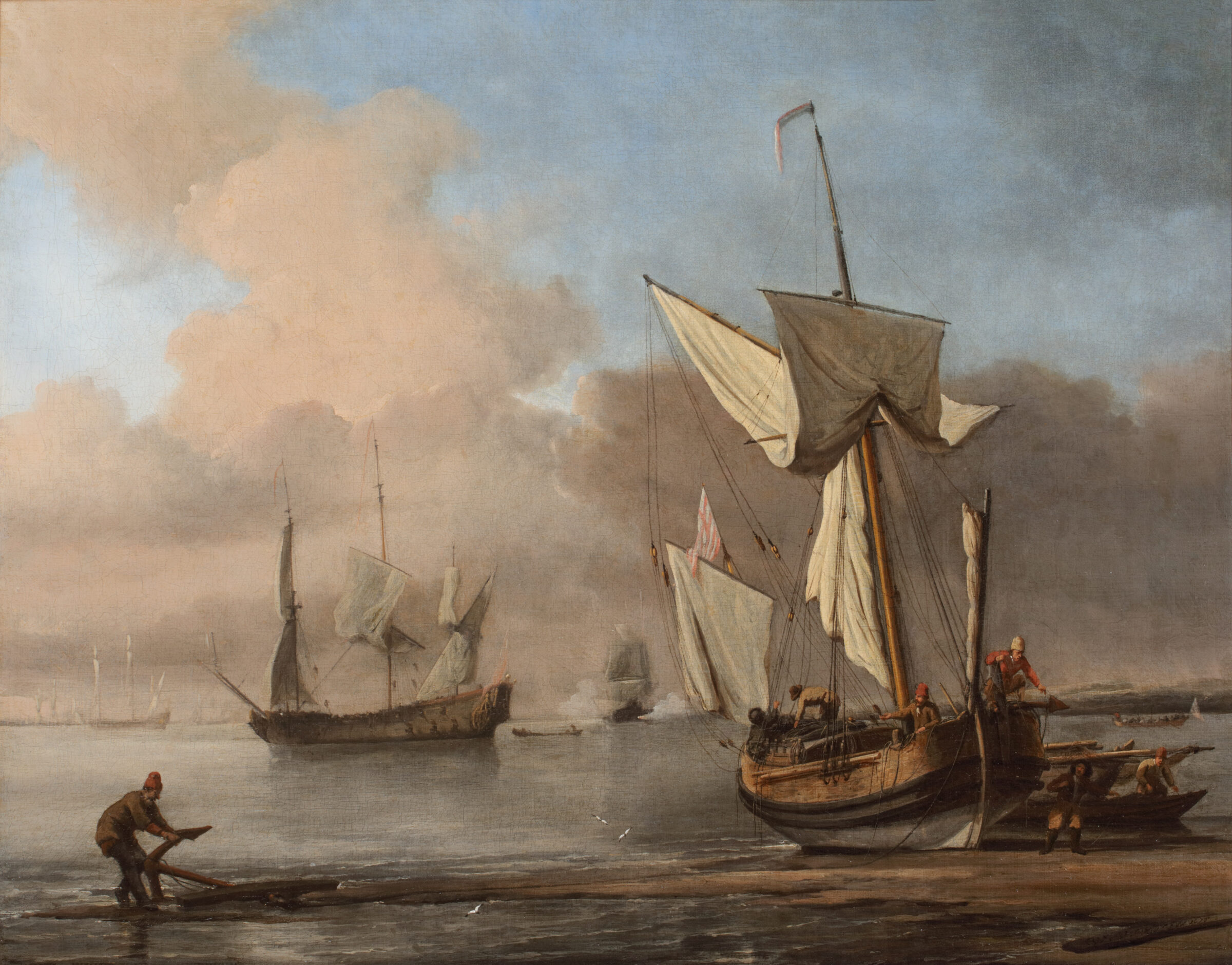
Oil on canvas 51,5 x 64,5 cm.
Signed and dated lower right WV Velde 167(8)
Provenance
Madame E.T.
auction Hôtel Drouot, Paris, 20 March 1912, lotno. 7
collection Emil Glückstadt
auction Winkel & Magnussen, Copenhagen, 2-5 June 1924, lotno. 694
private collection, Switzerland
Literature
M.S. Robinson, Van de Velde, A catalogue of the paintings of the elder and the younger Willem van de Velde, Vol. II, Greenwich, National Maritime Museum 1990, p. 694, nr. 439.
Willem van de Velde the Younger was born in Leiden, the son of the painter Willem van de Velde the Elder. He was known for his monochrome depictions of ships, for which he made sketches that he later translated into ink paintings on canvas or panels, previously prepared with a white primer. He initially learned the fundamentals of his art in his father’s workshop, but from 1648 to 1651 he was also taught by Simon de Vlieger, a relative of the family. Van de Velde’s family had settled in Amsterdam. The artist worked there until 1672, which the Dutch call the ‘Rampjaar’ (unlucky year). Many artists felt the full force of the economic collapse caused by the French invasion and were driven into exile. Willem van de Velde was forced to settle in England to earn his living. In 1674, he and his father entered the service of King Charles II. To attract talent from the continent, the English ruler offered the newcomers numerous benefits, such as religious freedom and tax exemptions. Upon his arrival in London, Van de Velde received an annual pension and a studio in the Queen’s House in Greenwich. In 1691, he moved to Westminster.
This painting was created during this English period, which is confirmed not least by the angular script of the signature, which is typical of Willem van de Velde’s activities in England. In the foreground, a boat (British East India Company), has reached the mainland. The flag allows us to identifyit as an English ship. Red and white striped and bearing the Cross of St. George, it appears to be the flag of the British East India Company, founded in 1600 by Queen Elizabeth I of England. The fading light at the end of the day gives the painting a serene atmosphere, which was evidently sought after by Van de Velde’s clients.
The catalogue raisonné of the works of father and son Van de Velde, compiled by Michael Robinson, reveals that Willem van de Velde regularly produced depictions of ships in calm weather. However, the painter also created more turbulent seascapes, in which the ships face a stormy sea, which were intended to appeal to a different audience. These ship views and seascapes led to numerous variants, which were energetically produced by Willem van de Velde and his studio. The latter consisted, among others, of various family members such as his young son Cornelis van de Velde and his brother-in-law Johan van der Hagen. Willem van de Velde played a leading role in the development of marine painting in the 17th century, first in the Republic of the United Netherlands, where this genre emerged in the years 1610–1620, and then in England in the second half of the century. His works were a great success during his lifetime and shaped the English school of painting after 1700.
Share this artwork: