
Painter of Light, Landscape, and Idealized Nature
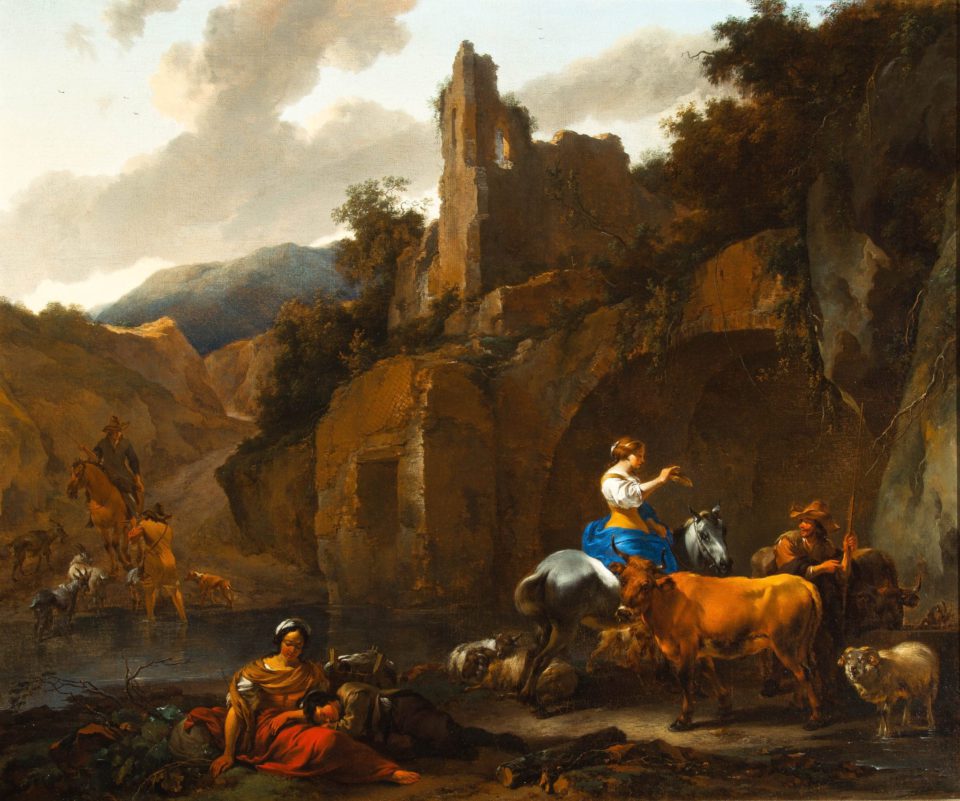
Nicolaes Berchem was one of the leading painters of Italianate landscapes during the Dutch Golden Age. Born in Haarlem in 1620, Berchem developed a distinctive style that blended Dutch naturalism with the warm light, classical ruins, and idyllic scenes of southern Europe, creating paintings that appealed to the imagination of a northern audience longing for the beauty and harmony of a distant, idealized world.
Berchem came from an artistic family. His father, Pieter Claesz, was a renowned still life painter, and Berchem himself was apprenticed to several prominent artists, including Jan van Goyen, Nicolaes Moeyaert, and Jan Wils. From these mentors, he absorbed lessons in composition, atmosphere, and landscape construction. It is believed that he may have traveled to Italy, although no definitive records survive. Regardless, the influence of Italy its glowing skies, classical architecture, and pastoral life infuses nearly all of his mature work.
Berchem’s paintings are typically populated by shepherds, travelers, and animals, set against luminous landscapes bathed in golden light. His scenes evoke a tranquil, almost theatrical Arcadia, blending elements of genre painting with fantasy. Cattle, goats, and pack animals play a prominent role, often arranged in rhythmic groupings that add movement and structure to the compositions. These figures, while small in scale, are handled with great sensitivity and detail.
One of Berchem’s greatest strengths was his use of light and atmosphere. His landscapes often glow with a southern radiance, the sun low on the horizon, casting long shadows and bathing the hills and ruins in a golden hue. This mastery of light made his work especially appealing to collectors of the time and contributed to the popularity of the Italianate landscape genre in the Netherlands.
Although best known as a landscape painter, Berchem was also a gifted draughtsman and printmaker, producing numerous drawings and etchings that display his fluid line and compositional skill. His versatility extended to history paintings and allegorical subjects, though these were less central to his fame.
Berchem was highly successful during his lifetime. He worked in Amsterdam, Haarlem, and The Hague, and was sought after by art dealers and wealthy patrons. His paintings were widely collected, and he influenced a generation of artists, including Karel Dujardin, Jan Both, and Johann Heinrich Roos. His distinctive style at once romantic, refined, and harmonious was also emulated by later European painters well into the 18th century.
He died in Amsterdam in 1683, leaving behind a large and varied body of work. Today, Nicolaes Berchem is remembered as one of the finest Dutch Italianate painters, a master of pastoral mood, idealized form, and sunlit serenity. His paintings continue to transport viewers to imagined southern landscapes, where the rhythms of rural life unfold in harmony with nature and light.
Share this: