
Two Voices of Still Life: From Opulence to Restraint
Jan Jansz. den Uyl and Jan Jansz. Treck were two highly skilled but stylistically distinct still life painters active during the Dutch Golden Age, a period of immense artistic flourishing in the 17th century. Bound by both artistic influence and family ties, their work represents a shift in still life painting—from the elaborate displays of wealth to quieter, more reflective compositions. Together, they offer a rich dialogue on luxury, transience, and the beauty of the everyday.
Jan Jansz. den Uyl (c. 1595–1639): Painter of Opulent Banquets
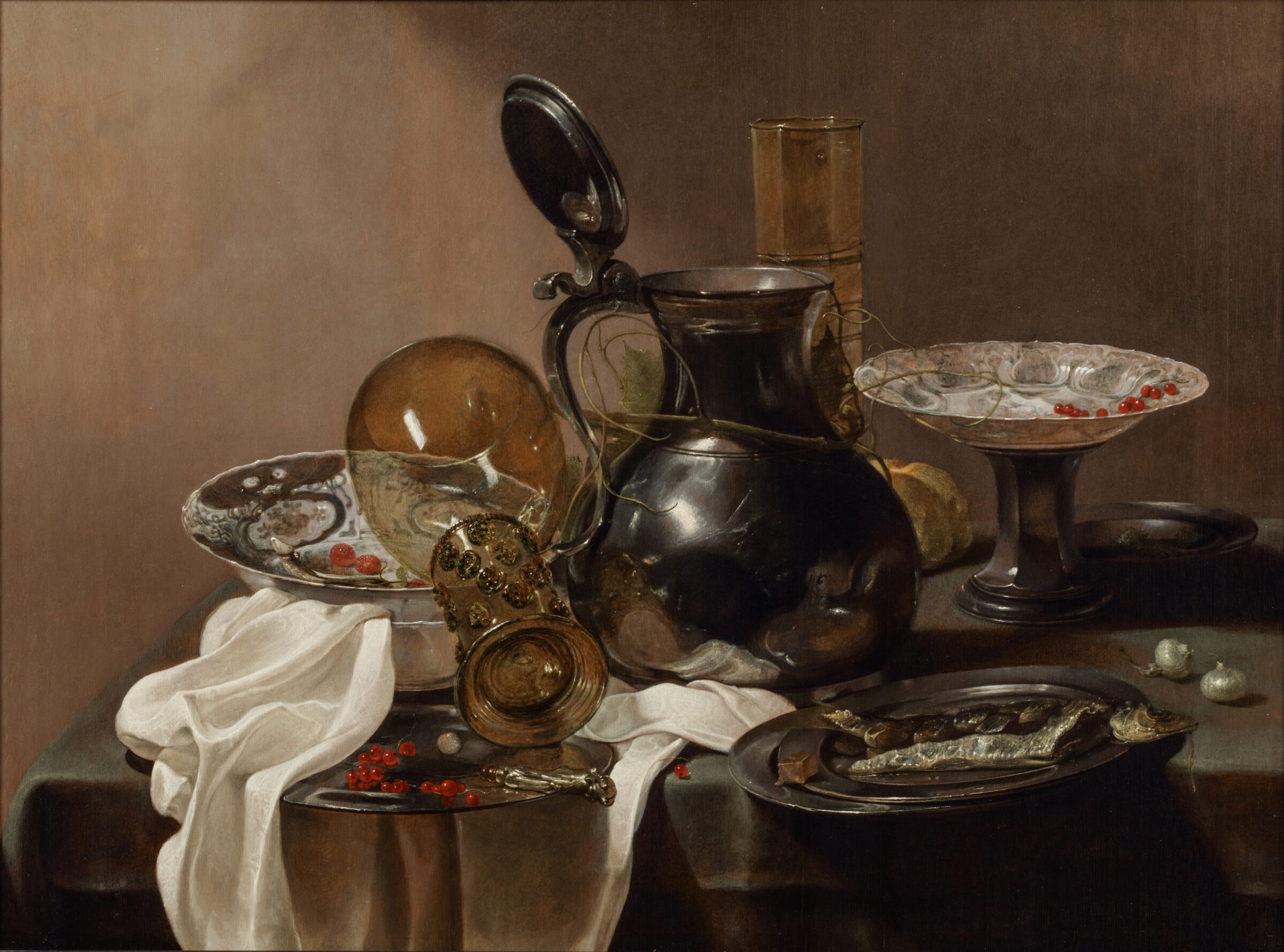
Den Uyl was born in Amsterdam and became known for his luxurious ontbijtjes (breakfast pieces) and banquet still lifes. His works typically feature fine objects such as silver goblets, Venetian glassware, Chinese porcelain, pewter plates, and imported fruit, carefully arranged in complex compositions. His use of light and shadow, precise textures, and subtle symbolism reflects the wealth and worldly curiosity of the Dutch Republic at its height.
Den Uyl’s paintings often contain vanitas elements—items like burning candles, timepieces, or overturned glasses—that remind viewers of the fleeting nature of luxury and life. A hallmark of his style is the use of reflective surfaces and careful rendering of different materials, which invite close inspection and reward the attentive viewer.
Though he never achieved widespread fame in his lifetime, den Uyl’s work was admired by connoisseurs. Even Rembrandt owned at least one of his paintings, a testament to the respect he commanded among peers. He died in 1639, leaving behind a small but highly refined body of work.
Jan Jansz. Treck (1606–1652): The Quiet Evolution
Jan Jansz. Treck was den Uyl’s brother-in-law, pupil, and later his artistic heir. After training in den Uyl’s workshop, Treck developed a more austere, introspective style. While he initially painted in his mentor’s tradition, Treck gradually moved toward simpler compositions, with fewer objects, softer lighting, and a more philosophical tone.
His paintings are known for their minimalism and subtle symbolism. A pipe, a loaf of bread, a knife, or a folded napkin might be the only elements present—yet each is carefully chosen and placed to evoke a sense of time, mortality, and stillness. Treck’s muted color palette and spacious compositions reflect a quiet discipline, aligning his work with the growing interest in moral reflection and modesty during the later 17th century.
Treck’s move from den Uyl’s rich banquet scenes to his own serene still lifes represents a broader shift in Dutch art—from the display of wealth to a more spiritual and contemplative focus. He died in Amsterdam in 1652, at the age of 46, leaving a powerful legacy through his restrained and thoughtful still lifes.
Together, JAN JANSZ DEN UYL AND JAN JANSZ TRECK embody two distinct responses to the same world—one celebrating its richness, the other reflecting on its impermanence. Their works, often modest in size but rich in meaning, continue to resonate with modern viewers for their technical brilliance, philosophical depth, and timeless observation of human life through inanimate things.
Though Jan Jansz. den Uyl and Jan Jansz. Treck shared a close personal and artistic bond, their works represent two distinct approaches within the still life tradition. Den Uyl celebrated the refinement and abundance of the Dutch Golden Age with meticulously rendered objects that dazzled with texture and complexity, while Treck distilled the genre to its quiet essence—favoring restraint, simplicity, and introspection. Together, their paintings form a compelling dialogue between opulence and austerity, earthly pleasure and spiritual reflection, offering viewers not just technical mastery, but enduring insights into the fleeting nature of time, material wealth, and human experience.
Share this: